Components of Electric Vehicles
Core Components of Electric Vehicles: Motor, Battery, Converter & Controller
In today’s class, we explored the fundamental building blocks that define an Electric Vehicle (EV). Unlike internal combustion engine vehicles, EVs rely completely on electrical propulsion and portable electrochemical energy sources. This simple but powerful architectural shift leads to a clean, efficient, and mechanically simpler powertrain.
This blogpost summarizes the system-level understanding of EV components we discussed today, helping students appreciate how each subsystem contributes to the overall performance of an electric vehicle.
What Makes an EV Unique?
EVs stand apart from ICE vehicles primarily in two ways:
- The energy source is portable and chemical/electromechanical in nature
– Typically a battery, fuel cell, or flywheel. - Traction is provided solely by an electric motor
– No multi-stage engine, combustion chamber, or fuel injection system.
These two features shape every major design decision in EV architecture.
Top-Level View of an EV System

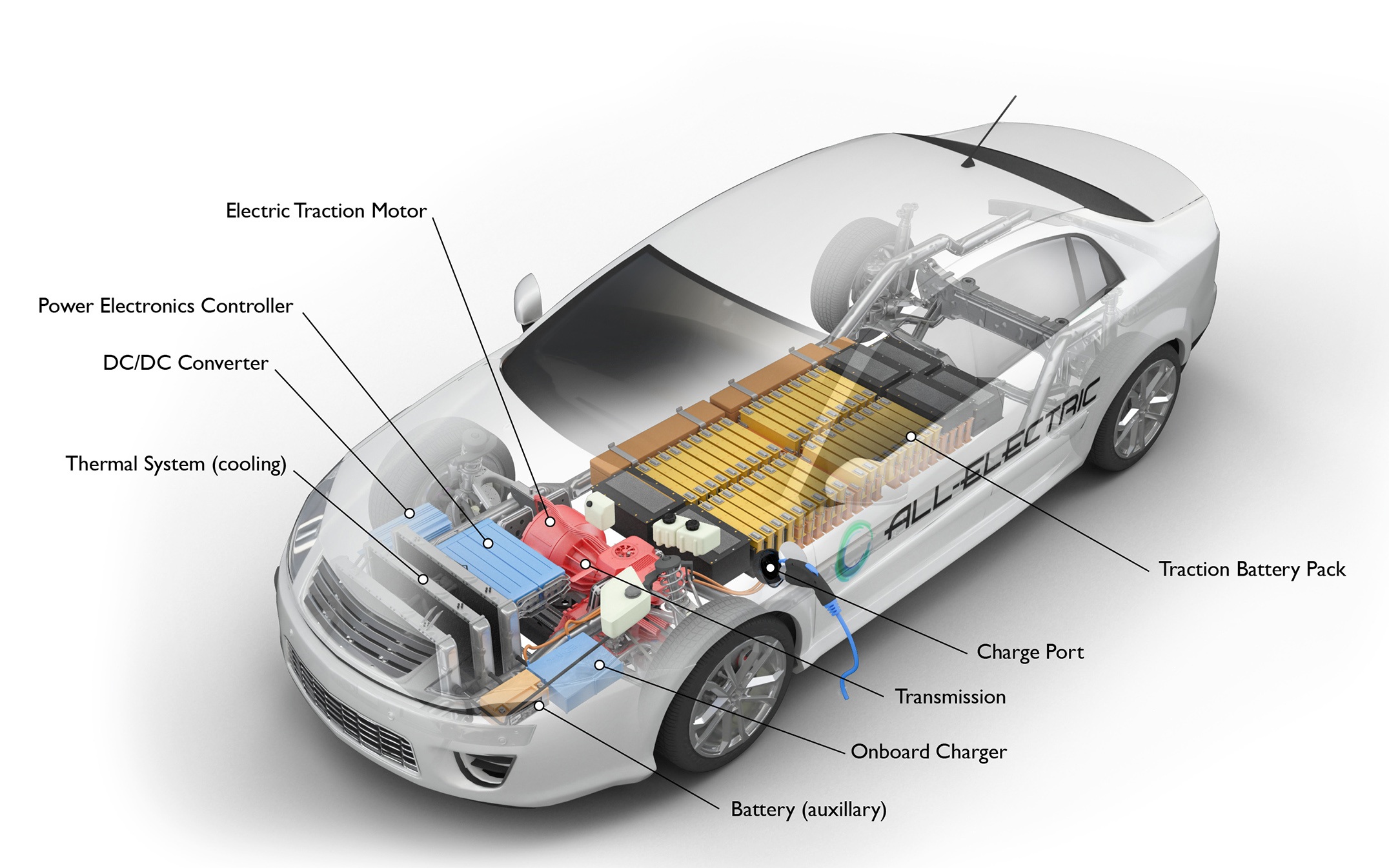
As we saw in Figure 1.2 during class, an EV consists of:
- A portable energy source (battery, fuel cell, hybrid storage)
- A drivetrain that converts electrical energy → mechanical motion
- Mechanical transmission elements delivering torque to the wheels
Both electrical and mechanical subsystems work together to determine efficiency, performance, and driving dynamics.
Primary Components of an EV System

The essential components include:
Electric Motor: The heart of the propulsion system.
EVs commonly use:
- DC motors
– Simple control, but high maintenance and brush wear. - Induction motors
– Low cost, robust, maintenance-free, widely adopted. - Permanent magnet (PM) synchronous motors
– High power density, excellent performance; magnets are costly. - Switched reluctance motors
– Good torque and low cost; noise issues limit adoption.
Modern motor design involves electromagnetic, thermal, and mechanical optimization, supported by CAD and finite-element tools.
Battery / Energy Source: Traditionally, lead-acid batteries dominated early EVs due to low cost and mature technology.
However, EVs today increasingly use:
- NiMH
- Li-ion (dominant in modern EVs)
- Na-NiCl₂
- Solid-state prototypes
Batteries supply DC energy, which must be converted by power electronics to run the motor.
They require a charger to restore charge once depleted.
The limited driving range of battery EVs historically pushed industry to explore:
- Fuel cells
- Flywheels
- Hybrid architectures
Fuel cells, in particular, remain a promising zero-emission long-range solution.
Power Electronics Converter: The “bridge” between battery and motor.
A converter:
- Converts fixed DC battery voltage → variable voltage & frequency (for AC motors)
- Controls torque, speed, regenerative braking, and efficiency
- Includes high-power semiconductor devices such as:
– IGBTs
– MOSFETs
– Fast diodes
– SCRs (in earlier designs)
Over the past several decades, advancements in power electronics have been the single most important enabler of modern EVs.
High-power compact devices and advanced cooling methods allow lightweight, highly efficient motor drives.
Controller: The “brain” of the EV propulsion system.
The controller performs:
- Motor drive control (inner loop)
- System-level control (outer loop)
- Regeneration management
- Thermal protection
- Fault detection
Controllers now rely on:
- High-speed microprocessors
- Digital Signal Processors (DSPs)
- VLSI technology
These enable precise implementation of complex algorithms, such as:
- Vector control
- Field-oriented control (FOC)
- Direct torque control (DTC)
- Battery management strategies
This computational capability is the key reason modern EVs are smooth, responsive, and energy-efficient.
Why Understanding EV Components Matters
From our discussion, students recognized that an EV is not just a vehicle with a battery—it is a highly integrated electro-mechanical system.
A strong grasp of each component’s role helps engineers:
- Diagnose performance issues
- Design efficient drivetrains
- Innovate new EV architectures
- Integrate batteries, converters, and motors effectively
This foundation will be essential as we move into energy storage systems, charging infrastructure, and hybrid configurations.



latest video


news via inbox
Nulla turp dis cursus. Integer liberos euismod pretium faucibua