Battery Electric Vehicles (BEVs): Pure Electric Mobility
In today’s EV course session, we focused on the most fundamental category of electric vehicles—the Battery Electric Vehicle (BEV). BEVs represent the purest form of electric mobility, as they rely entirely on electrical energy stored in batteries to power the drivetrain. There is no internal combustion engine, no fuel tank, and no tailpipe emissions.
What Is a Battery Electric Vehicle (BEV)?
A Battery Electric Vehicle (BEV) is an EV in which:
- Batteries are the sole energy source
- Traction is provided only by electric motor(s)
- Energy flows from the battery → power converter → motor → wheels
Since BEVs depend completely on stored electrical energy, their driving range is directly linked to battery capacity.
Driving Range and Charging Characteristics
Typical BEVs can travel:
- 100–250 km per charge for standard models
- 300–500 km per charge for premium or long-range models
The actual range depends on several factors:
- Driving style and traffic conditions
- Vehicle weight and configuration
- Road conditions and terrain
- Climate and ambient temperature
- Battery type, capacity, and age
Charging Time
Once the battery is depleted, recharging takes significantly longer than refuelling an ICE vehicle:
- Slow charging: Can take up to 36 hours for a full charge
- Faster charging options: Reduce charging time substantially, but still cannot match the few minutes required to refill a fuel tank
Charging time depends on:
- Charger power level
- Charging infrastructure
- Battery capacity and chemistry
Advantages of BEVs
BEVs offer several strong advantages that make them ideal for modern urban transportation:
- Zero greenhouse gas (GHG) emissions at the tailpipe
- No noise pollution, resulting in quieter cities
- Simple construction with fewer moving parts
- Lower maintenance requirements
- Instant and high torque, even at low speeds
- Smooth and responsive driving experience
These features make BEVs particularly well-suited for city driving, daily commuting, and short-to-medium distance travel.
Limitations of BEVs
Despite their benefits, BEVs face some practical challenges:
- Limited driving range compared to ICE vehicles
- Longer charging times, especially with slow chargers
- Dependence on charging infrastructure availability
Because of these limitations, BEVs are most effective in applications where predictable routes and access to charging are available.
Examples of Popular BEVs
Some of the most successful BEVs in the market today include:
- Nissan Leaf
- Tesla models (Model 3, Model Y, etc.)
- Several high-volume Chinese electric vehicles
These vehicles demonstrate how advances in battery technology and power electronics are steadily overcoming earlier limitations of BEVs.
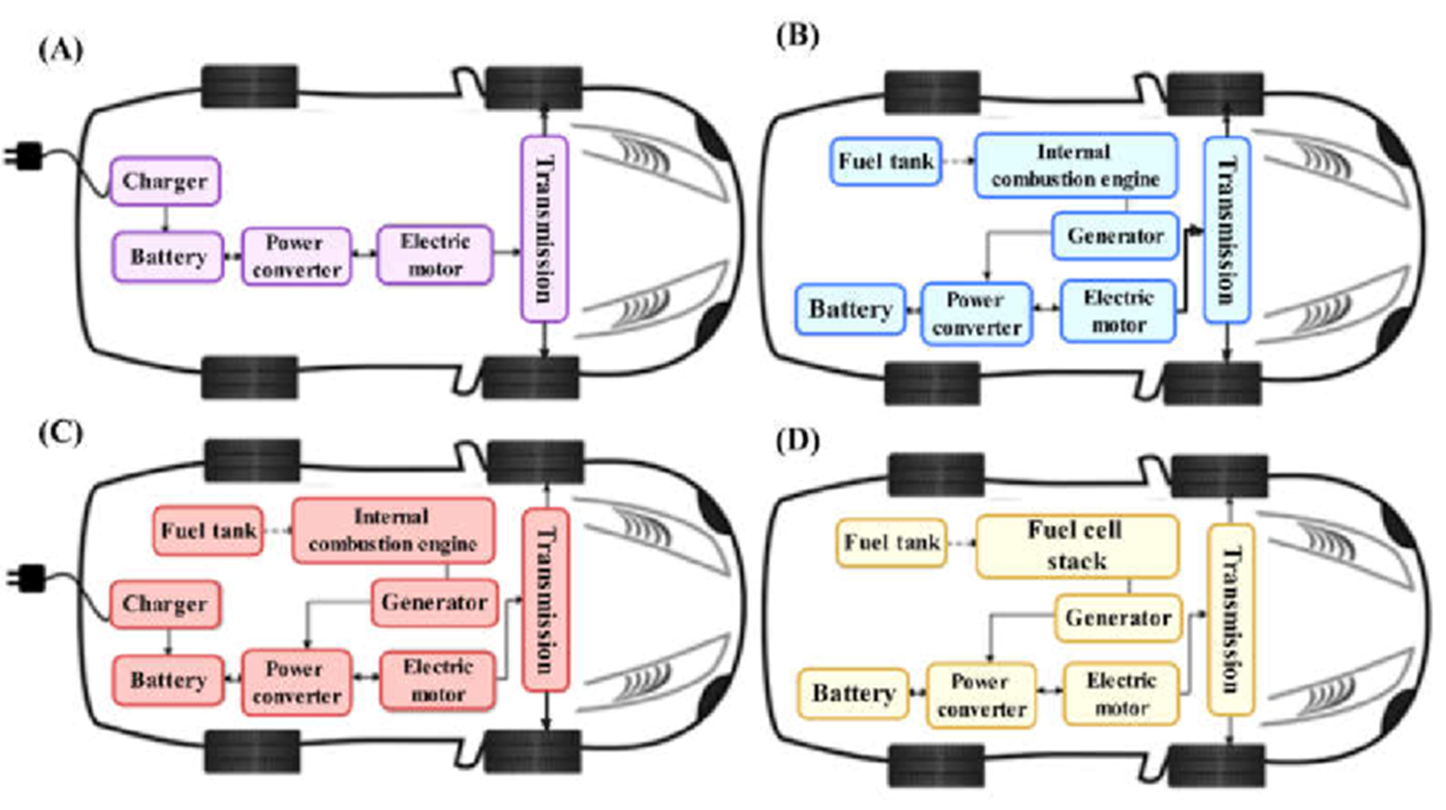
Basic Configuration of a BEV
As shown in Figure 1.4 discussed in class, the BEV configuration is straightforward:
- Battery pack supplies DC power
- Power converter conditions the electrical supply
- Electric motor(s) drive the wheels directly
This simplicity is one of the strongest technical advantages of BEVs over ICE-based vehicles.



latest video


news via inbox
Nulla turp dis cursus. Integer liberos euismod pretium faucibua