Hybrid Electric Vehicles (HEVs): Blending Electric and Conventional Power
Hybrid Electric Vehicles (HEVs)—vehicles that combine an internal combustion engine (ICE) with an electric propulsion system. HEVs represent a practical transition between conventional ICE vehicles and fully electric vehicles by improving fuel efficiency and reducing emissions without depending on external charging infrastructure.
What Is a Hybrid Electric Vehicle (HEV)?
A Hybrid Electric Vehicle (HEV) uses:
- An internal combustion engine (ICE)
- An electric motor (EM)
- A battery and power electronics
The vehicle intelligently switches between—or combines—these two propulsion systems depending on operating conditions.
HEVs primarily use electric propulsion during low-power demand situations, such as:
- Low-speed urban driving
- Stop-and-go traffic
- Idling conditions
This allows the ICE to remain off during inefficient operating modes, significantly reducing fuel consumption and greenhouse gas (GHG) emissions.
Operating Modes of an HEV
HEVs are designed to dynamically manage power flow between the ICE and the electric motor:
- Low-speed operation: Vehicle runs on electric motor alone
- High-speed or high-load operation: ICE becomes the primary power source
- Combined operation: ICE and electric motor work together to improve performance
This hybrid operation is particularly useful in applications such as turbocharged vehicles, where electric motors help eliminate turbo lag and enhance acceleration. A notable example is the Acura NSX, which uses hybrid technology for performance enhancement.
Energy Recovery and Battery Charging
HEVs do not rely on external charging. Instead, they recharge the battery through:
- Engine-driven generation: ICE operates the motor as a generator
- Regenerative braking: Kinetic energy during braking is converted into electrical energy and stored in the battery
These features make HEVs largely self-sustaining in terms of energy.
Power Flow in an HEV
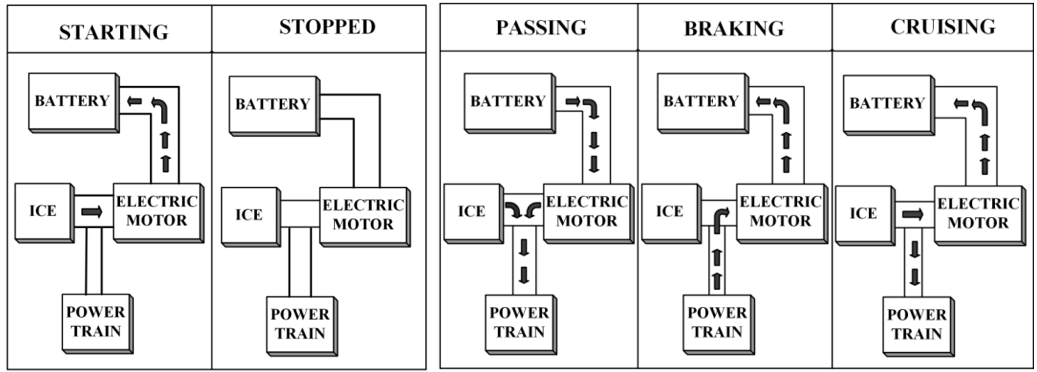
As illustrated in Figure 1.5, the direction of power flow varies with driving conditions:
- Vehicle start: ICE may drive the motor as a generator to charge the battery
- Acceleration or overtaking: ICE and electric motor jointly drive the powertrain
- Cruising: ICE drives the vehicle and simultaneously charges the battery
- Braking: Electric motor operates as a generator to recover energy
- Vehicle stop: Power flow ceases
This intelligent energy management system continuously considers parameters such as:
- Vehicle speed
- Driver input
- Battery state of charge (SOC)
- Motor speed
to maximize fuel efficiency and overall performance.
Why HEVs Matter
Although HEVs are not zero-emission vehicles, they offer several practical benefits:
- Reduced fuel consumption
- Lower GHG emissions compared to ICE vehicles
- Improved acceleration and drivability
- No dependence on charging infrastructure
For these reasons, HEVs are widely adopted by manufacturers as an effective solution for improving efficiency in conventional vehicles.
Concluding Remarks
Hybrid Electric Vehicles demonstrate how electrical engineering concepts—motor drives, power electronics, and control systems—can significantly enhance traditional automotive platforms. HEVs serve as an important stepping stone toward fully electric mobility while offering immediate environmental and performance benefits.



latest video


news via inbox
Nulla turp dis cursus. Integer liberos euismod pretium faucibua